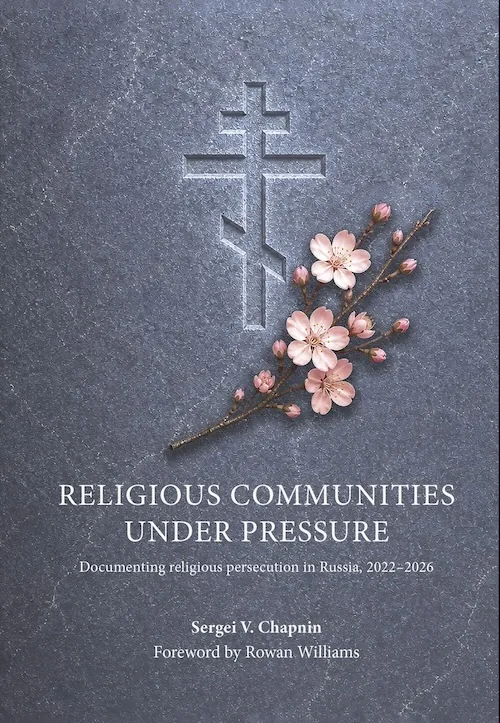
Religious Communities Under Pressure by Sergei Chapnin — book cover, dark red typography on a cream background Buy on Amazon
Paperback $17.09  ·  Kindle $9.99
★ 4.7 (13 ratings)  ·  163 pages

Religious Communities Under Pressure

Documenting Religious Persecution in Russia 2022–2026
Featured in The Wall Street Journal  ·  First Things Summer Reading List  ·  Reviewed in Providence and RGOW

Since 2022, more than 120 believers have been silenced, defrocked, or imprisoned for refusing to bless Russia's war. This is their record — written from inside the Church that helped persecute them.

Since February 2022, Orthodox priests and deacons have been defrocked for praying for peace. A non-denominational preacher who walked out holding a sign that read "No to War" was later found dead in a penal colony. Across Russia, believers who refused to bless the war have been silenced, stripped of their orders, and imprisoned — not only by the state, but by their own Church.

Religious Communities Under Pressure brings that record to English for the first time. It documents more than 120 believers — Orthodox, Protestant, Jewish, and Buddhist — and traces the machinery behind their persecution: a system more intricate, and in some ways more insidious, than anything the Soviet state devised. The great majority are Orthodox Christians, the only ones pressed from two directions at once — by the state, and by a Church that has surrendered its freedom to it.

Chapnin writes from within that Church. For fifteen years he shaped the media policy of the Moscow Patriarchate. In December 2015 he warned publicly that Russia was remaking Orthodoxy into a state ideology, and that a future war against Ukraine would be given a religious justification. Within weeks, Patriarch Kirill dismissed him. Seven years later, the warning proved exact.

"As former patriarchate official Sergei Chapnin documents in his book Religious Communities Under Pressure, the Russian Orthodox Church persecutes and disowns any of its clergy and laity who oppose the war on Ukraine."
— George Weigel  ·  The Wall Street Journal, August 2026
"Through dozens of case studies, an expert on Russian Orthodoxy describes the corruption of the Church he loves by its willful self-subordination to the power of the Kremlin."
— George Weigel  ·  First Things, Summer Reading List, 2026
"Chapnin’s masterful ability to dispel three common misconceptions about the Russian religious landscape makes the book truly essential reading. … Through his meticulous research and insightful analysis, Chapnin paints a picture of a political regime and a national church united by a heretical ideology that portrays Ukraine and the West as demonic enemies of Russian religion, and the war on Ukraine as a sacred duty."
— Siobhan Heekin-Canedy, Contributing Editor  ·  Providence, September 2026
"Chapnin presents information … that, in the form of this reference work, will serve all who are interested in the religious dimension of Russia’s war of aggression against Ukraine. The useful appendix contains names, forms of repression, and sources of information."
— Regula M. Zwahlen, Editor  ·  Religion & Gesellschaft in Ost und West, October 2026 (in German; our translation)
German original

„Chapnin präsentiert Informationen, […] die allen, die sich für die religiöse Dimension des russischen Angriffskriegs auf die Ukraine interessieren, in Form dieses Nachschlagewerks dienen werden. Der nützliche Anhang enthält Namen, Repressionsformen und Informationsquellen.“

"Chapnin's book does more than describe what is happening in Russia today — it answers the question 'why?' The study lays bare the God-defying nature of Putin's regime behind its outward tolerance of religious life."
— Archpriest Andrey Kordochkin  ·  Postimees, September 2026 (in Russian)
Also reviewed
"An essential volume for a current view of the repressive actions of the Moscow Patriarchate led by Patriarch Kirill and the Russian state."
— Jacqueline Xenia Nenchin, former translator and archivist at Keston College  ·  Substack, July 2026

Journalists and policy analysts covering Russia, religious freedom, or the war against Ukraine. The draw is the analysis itself — a thorough reading of how the persecution works, and why, built on an unusually rich body of documented cases and primary sources.

Christians beyond the Orthodox alone. The book records believers of other confessions silenced for the same refusal, and sets the Orthodox cases among them. Its question is not abstract: the persecuted are waiting for support, and the churches still free to give it have to decide what that will be.

Scholars of religion, human rights, and post-Soviet politics. The first English-language study to map ecclesiastical, state, and cross-religious repression as a single system.

Government and NGO practitioners working on Countries of Particular Concern designations, sanctions, or refugee support. The book offers targeted recommendations for U.S., EU, and ecumenical bodies.

Excerpt
"By 2022 a schism had opened within Russian Orthodoxy itself — between the official Church, aligned with the state, and the parishes and clergy who recoiled from the Patriarch's blessing of violence. Patriarch Kirill's claim to be its sole legitimate voice is itself part of the persecution. To the outside world the Church appears unified behind him. This report documents the persecution that produced that appearance."
"Courageous, comprehensively documented, written out of indignant loyalty to a Church whose public spokespersons seem set on destroying its own credibility, it is a necessary and timely book that should be studied by all who want to understand the draining, disgraceful conflict that continues to overshadow Eastern Europe."
Rowan Williams, former Archbishop of Canterbury — from the Foreword
"The testimony gathered in this book is the moral answer to the gravest temptation the Russian Church has faced in a century, since its hierarchy's 'Sergian' collaboration with the Soviet state."
Vladimir Kara-Murza, former political prisoner and Pulitzer Prize–winning columnist
"He ultimately recalls the essential vocation of faith as a moral compass and not a tool in the service of political power."
Archbishop Elpidophoros of America
"This book obliges them — and us — to look into a mirror that reflects a painful reality before which we cannot remain silent."
John Chryssavgis, advisor to Ecumenical Patriarch Bartholomew
★★★★½  4.7 out of 5  ·  13 ratings on Amazon
★★★★★
"Chapnin's carefully documented case studies of the persecution of not only Russian Orthodox clergy but those of other faiths demonstrate the ongoing abuse of the unholy alliance of the Russian president and the Patriarch."
Carol Ueland, Professor of Russian, Drew University
Verified purchase · September 2026
★★★★★
"The author's Russia is not just a distant cautionary tale; it is a mirror... Read it as a warning about us — about what happens to Orthodoxy of the Russian tradition in America if we look away."
Svetlana Vais, journalist, USA
Verified purchase · July 2026
★★★★★
"Not simply a critique of the Russian Orthodox Church, nor merely another book about the war. It is a carefully documented record of what happened to religious believers whose conscience prevented them from remaining silent."
Archpriest Volodymyr Zablotskyy (OCA), USA
Verified purchase · June 2026

Have you read the book? If it was useful to you, please leave a review on Amazon. Reviews help more than you might think: they shape how often Amazon shows the book to readers who have never heard of it.

Write a review on Amazon
September 15, 2026
George Washington University — Elliott School of International Affairs, Washington, D.C.
Hosted by The Russia Program at GW
Book talk moderated by Dr. Peter Rollberg, Professor of Slavic Languages, Film Studies, and International Affairs.
July 1, 2026
European Academy of Religion — Ninth Annual Conference, LUISS University, Rome
Panel "Religious Communities Under Pressure," with Very Rev. Andrey Kordochkin (University of Göttingen) and Dmitry Uzlaner (Freie Universität Berlin).

To invite Sergei Chapnin to speak at your university, church, or conference, get in touch.

Nine chapters and eight appendices of primary-source lists — foreign agents, banned organizations, imprisoned believers.

Show full table of contents
Foreword by Rowan Williams7
Chapter 1 · Introduction: A Call to Bear Witness23
Regional Context: A Shared Zone of Repression26
Scale and Scope of Documented Persecution27
Historical and Theological Context28
Practical Impact and Corroboration30
Chapter 2 · The Official Church as an Instrument of War31
From "Church Revival" to "Church of Empire"31
Institutional Integration with Security Services33
Episcopal Support for the War36
Chapter 3 · State Mechanisms of Religious Suppression41
Moral Segregation: An Informal Mechanism of Exclusion41
Extra-Judicial Designation Mechanisms44
Judicial Persecution Mechanisms45
The "Foreign Agent" Mechanism: Weaponizing Bureaucracy46
Administrative Offenses as the Gateway to Persecution48
Criminal Prosecutions: Severe Penalties for Religious Expression49
Military Conscription as Punishment51
Patterns of Persecution52
The Human Cost of Persecution54
Methods of Investigation and Prosecution60
The Intersection of Civic and Religious Dissent63
Chapter 4 · Strategic Coordination Between Church and State65
From Institutional Alignment to Operational Coordination65
The ROC's Unique Position in the Repressive Apparatus68
Operational Coordination in Persecution Cases68
The Strategic Purpose of Dual Pressure69
Chapter 5 · Ecclesiastical Mechanisms of Suppression75
Internal Church Discipline and Canonical Prosecutions75
Mandatory "Victory" Prayer and Punishment for Refusing to Read It78
"Oath-breaking" Charges as Canonical Distortions of Ecclesiastical Courts80
Methodical Ecclesiastical Persecution81
Chapter 6 · Cross-Religious Dimensions of Persecution83
Dissent from the Summit: The Buddhist Regions83
A Parallel Track: Persecution of Jehovah's Witnesses in Russia88
Chapter 7 · Patterns of Resistance and Exodus91
Silent Resistance: Withdrawal from the System91
A New Practical Ecumenism of Bold Joint Action93
Jurisdictional Exodus: Recourse for Clergy and Monastics98
Jurisdictional Exodus: Parishes and Clergy Leaving the Moscow Patriarchate101
Collective Exodus: The Orsk Protestant Community102
Chapter 8 · Institutional Responses: Silence, Complicity, and the Limits of International Action105
Beyond Silence: Inter-Orthodox Complicity with the Moscow Patriarchate109
The Helsinki Statement: An Ecumenical Breakthrough111
U.S. Government Response: The State Department's CPC Designation113
International Response: Sanctions Against Pro-War Religious Leaders115
Chapter 9 · Conclusions and Recommendations: A Call to Break the Silence117
To the United States Government119
To the European Union and European Governments120
To Orthodox Churches Worldwide120
To All Christian Churches and Ecumenical Bodies121
To Academic and Educational Institutions122
Chapter 10 · A Word Addressed to the Russian Orthodox Church123
Appendices
1 · Appeal of the Clergy of the ROC for Reconciliation and an End to War127
3 · Religious Individuals and Organizations Designated as "Foreign Agents"133
4 · Religious Figures Designated as "Terrorists" by Rosfinmonitoring135
5 · Anti-War Believers Under Investigation, Convicted and/or Imprisoned (2022–2026)136
6 · Religious Organizations Designated as "Undesirable"142
7 · Clergy of the ROC Transferred to the Ecumenical Patriarchate (2022–2025)143
8 · Documentation Resources145
Acknowledgments151
Second edition, Revised and Updated  ·  Published September 5, 2026  ·  163 pages  ·  ISBN 979-8950169038  ·  English  ·  Paperback & Kindle

Where to buy

Available to bookstores and libraries worldwide through standard wholesale channels. ISBN 979-8-9501690-3-8

The documentation behind this book continues as independent, volunteer work. Support the work →