Religion and Repression in Wartime Russia: The Documented Scale
How the Russian state and the Russian Orthodox Church have punished believers who oppose the war against Ukraine: documented cases since February 2022, from fines and prison sentences to defrocking.
New in this update Two new criminal cases and two new convictions, one more “undesirable” organization, changes to the “foreign agents” registry, and, for the first time, counts of the bishops and judges involved. What changed since June 2026 →
Since February 2022 the Russian state has treated public opposition to the war as a threat to its security, and religious communities have not been exempt. Priests who refused to pray for victory, pastors who preached peace from the pulpit, lay believers who published a single post, the chief rabbi of Moscow and the supreme lama of Kalmykia who declined to support the invasion — all of them have met some part of the same machinery. It includes fines for “discrediting the army,” criminal charges for “fakes” and “justification of terrorism,” the labels “foreign agent” and “undesirable organization,” inclusion in the Rosfinmonitoring list of “terrorists and extremists,” and, for many, exile.
Orthodox clergy face a second line of pressure that has no counterpart in secular dissent. The disciplinary system of the Russian Orthodox Church has suspended, retired, and defrocked priests for the wording of their prayers and the content of their sermons. In several cases church and state acted in parallel against the same person. In others the church acted alone, and the punishment never reached a courtroom or a news report.
This summary brings together what can be established from open sources. It covers all faiths. Most of the documented cases concern Orthodox, Protestant, and Catholic Christians, but the figures also include Jewish, Muslim, and Buddhist religious leaders. Two kinds of numbers appear below, and they should be read differently. Registry figures (foreign agents, undesirable organizations, the Rosfinmonitoring list) include every religious entry, whatever the official reason given. Case figures (administrative, criminal, ecclesiastical) are limited to cases connected with the war.
All figures are minimums. Correspondence with political prisoners, conducted by human rights organizations and parish groups, shows that many prisoners identify as Christians whose civic stance is rooted in Gospel convictions, although their cases were never recorded as religious. Clergy are often disciplined quietly, and some of those punished ask that their names be withheld. The documented cases of clergy, activists, and communities therefore represent only the visible portion of a broader phenomenon.
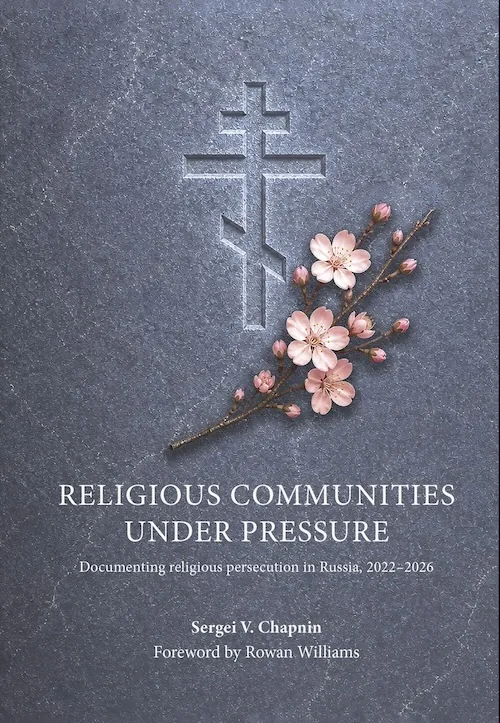
The figures update those published in Religious Communities Under Pressure (first edition, June 2026; second, revised edition, September 2026). Two items, the number of bishops directly involved in sanctions and the number of judges who ruled in criminal cases against anti-war believers, are counted here for the first time. Both are approximate, and the reasons are set out below.
The figures
Based on open sources, we document at least:
- 16religious figures and organizations designated as “foreign agents” by the Ministry of Justice. Fifteen remain on the registry; Archpriest Andrei Lvov was removed in August 2026.#
- 11religious or faith-based organizations listed as “undesirable.”#
- 7Christian clergy and activists placed on the Rosfinmonitoring list of “terrorists and extremists.”#
- No fewer than31administrative cases for anti-war religious speech, together with at least 3 fines imposed on clergy for ties to “undesirable” organizations.#
- 42criminal cases opened against believers and clergy. 31 have ended in convictions. Prison sentences range from 2.5 to 12 years, rising to 19 and 25 years in the cases of Alexei Navalny and Vladimir Kara-Murza; the remaining convictions ended in fines, compulsory labor, or suspended or deferred sentences.#
- 38Orthodox clergy subjected to ecclesiastical discipline in connection with their anti-war stance: 18 defrocked, 13 suspended from ministry, and 7 forced into retirement.#
- At least34believers and clergy subjected to searches, interrogations, or other direct pressure by the FSB and police; in at least 4 of these cases no charges followed. (Approximate; see below.)#
- At least35religious activists compelled into exile.#
- 3Christians who have died in Russian custody since the full-scale invasion.#
- At least12bishops of the Russian Orthodox Church in Russia, Patriarch Kirill among them, who personally imposed or approved sanctions against clergy for their anti-war stance; 3 more bishops did the same in the Belarusian Exarchate and in Western Europe. (Approximate; see below.) New#
- About30judges (at least 29 identified) who issued rulings in criminal cases against anti-war believers; 36 if the Navalny and Kara-Murza cases are included. (Approximate; see below.) New#
The consequences of inclusion in the registries of “foreign agents,” “undesirable organizations,” and “terrorists and extremists,” and the individual cases behind these figures, are set out in Religious Communities Under Pressure. Get the book →
What changed since June 2026
- Foreign agents: Rinat (Abdulla) Mukhametov, a Muslim scholar and former expert of the Council of Muftis of Russia, was added in September 2026; Archpriest Andrei Lvov was removed in August.
- Undesirable organizations: Child Evangelism Fellowship (July 2026).
- Rosfinmonitoring list: former priest Vasily Ptashinsky and Baptist pastor Yuri Sipko, both listed before June, were not reflected in the earlier figure.
- Criminal cases: new cases against Lida Moniava and the theologian Igor Zaitsev; new convictions of Vasily Ptashinsky (3 years 9 months) and the preacher Eduard Charov (a fine of 500,000 rubles).
- Administrative cases: a “discreditation” fine, imposed in May and reported in July, against Bishop Dimitry (Ignatov) of the Conciliar Orthodox Apostolic Church; fines for ties to “undesirable” organizations against Hieromonk Afanasy (Bukin), Archbishop Grigory Mikhnov-Voitenko, and an unnamed priest.
- Ecclesiastical discipline: Fr. Konstantin Kokora, suspended in 2024, was defrocked in June 2026.
Reading the figures
Criminal cases and convictions
We count cases opened, not only verdicts, because in wartime Russia the opening of a case is itself the decisive event. Every case in our list that has gone to trial and finished has ended in conviction, or in one instance in compulsory psychiatric treatment. Convictions include sentences handed down in absentia; the harshest of them, eight years in a penal colony for the journalist Ksenia Luchenko (March 2026), came at the end of a ten-month chain that also included her designation as a “foreign agent,” inclusion in the Rosfinmonitoring list, a federal search, and an arrest warrant. Of the eleven cases without a verdict, three concern people charged in absentia after leaving the country and not yet tried (Deacon Dmitry Baev, Nina Belyaeva, Pastor Yuri Sipko); two are trials under way behind closed doors (Denis Popovich and Nikita Ivankovich); three are still under investigation; one ended in compulsory psychiatric treatment rather than a sentence (Viktoriya Brazhnik). Pavel Kushnir, who died in pretrial detention in July 2024, and Lida Moniava, released under restrictions in September 2026 while her case proceeds, are rare exceptions to the usual course from arrest to prison.
In nine of the 42 cases, including five of the 31 convictions, there is no publicly confirmed evidence of an anti-war motive. Most of them concern donations to Ukrainian Protestant organizations, which court materials reportedly describe as support for the Ukrainian armed forces. We include them because the prosecutions arise from the war, and we mark them separately in the full case list. Without them, the count is 33 cases and 26 convictions.
Administrative cases
The figure rests on cases that became public through court websites, the defendants themselves, or religious-freedom monitors. Many fines under the “discreditation” article are never reported, and some clergy ask that their cases stay anonymous; one priest fined in September 2026 for reposting materials of a project that supports anti-war clergy is known only as “a cleric.” The real number is certainly higher.
Ecclesiastical discipline
The Russian Orthodox Church does not publish all of its disciplinary decrees, and some that were published have since been removed from official church websites. Many diocesan decisions become known only through the clergy concerned. The count of 38 includes only cases where the sanction and its connection with the war are documented. When a suspended priest is later defrocked, the breakdown shifts: in June 2026 Fr. Konstantin Kokora moved from the second category to the first.
Bishops
This figure is new and deliberately cautious. A bishop is counted when a published decree, a diocesan announcement, or press reporting of a specific act links him to a sanction against an anti-war cleric (10 cases), or when the cleric’s own account names him (2 cases). Bishops who merely governed the diocese at the time are not counted, nor are members of church courts and disciplinary commissions, whose participation in a particular decision usually cannot be proven: many dioceses do not publish the composition of their courts, and where it is published, it does not show who took part in a given case. The bishop responsible has not been identified for every one of the 38 disciplined clergy, so the true number is higher.
Judges
This is the roughest estimate in the summary. It draws on the OVD-Info database and on court reports, matched against the people in our list of criminal cases. OVD-Info links judges to a person rather than to a specific case and does not record the stage (pretrial detention, verdict, appeal), so the count combines all of them. Ten judges are known only by surname, and for some defendants convicted in 2026 the judges could not be identified. The number should be read as “about thirty,” not as an exact total.
Searches and other pressure by the security services
This figure counts people whose homes, churches, offices, or shelters were searched, who were taken in for interrogation or for a “conversation” at the FSB or the police, or who received direct threats from officers, when the episode is described in open sources. In most cases such a search is the first step of a criminal or administrative case, usually carried out at dawn and accompanied by the seizure of phones, computers, and sometimes icons, crosses, or vestments; these people also appear among the criminal and administrative figures above. In at least four cases no charges followed: the person was questioned as a witness and released with a non-disclosure pledge, was told by his bishop that he had come to the attention of the FSB, or was detained after pickets without any record being drawn up. This is the least visible form of pressure. Most episodes become known only if the person chooses to speak about them, and many do not, so the real number is certainly much higher.
Exile and deaths in custody
The exile figure includes only those whose departure is publicly linked to persecution; many left without announcement. The three deaths in custody are those of Alexei Navalny (February 2024), Pavel Kushnir (July 2024), and Christolyub Vegan (April 2026).
Sources
Registries of the Ministry of Justice of the Russian Federation (foreign agents; undesirable organizations); the Rosfinmonitoring list of “terrorists and extremists”; the OVD-Info database of political persecution; Memorial’s list of political prisoners; the monitoring of “Christians Against the War”; diocesan websites and official church publications; independent media. Individual cases, with references, are listed in the appendices to Religious Communities Under Pressure and in the project database.